Common gym mistakes (and how to avoid them)
Whether you're new to the gym or have been training for years, some habits can hold back your progress. A workout plan that doesn't fit your needs, sloppy technique or unrealistic goals can make your sessions less effective.
5 common gym mistakes and how to avoid them
1. Expecting results too quickly
Showing up at the gym with an ambitious goal but no idea how to reach it can be discouraging. You try different exercises without following a clear plan, but results are slow to come and your exercise motivation starts to fade.
Myriam's tip: Start with a fitness assessment to see where you stand and set realistic goals. Lasting results take time.
2. Training without a structured plan
Choosing your strength training exercises based on whichever machines are free doesn't guarantee a balanced workout.
Myriam's tip: Follow a strength training program that spells out the exercises, sets, reps and weights. Plan which muscle groups you'll work in each session and log your weights to track your strength training progression from week to week.
3. Skipping professional guidance
It's entirely possible to train on your own. Without guidance, though, some technical errors can go unnoticed, or some exercises may not suit your needs.
Myriam's tip: A few personal training sessions can help you learn the right movements, develop proper lifting technique and leave with a workout plan tailored to your needs.
4. Believing you can target fat loss
Want to lose belly fat, so you only do ab exercises? It's a common misconception. These exercises strengthen your abdominal muscles, but they don't let you choose where your body loses fat. Fat loss depends on several factors, including physical activity, diet, sleep and genetics.
Myriam's tip: Focus on a full-body workout that combines strength training and cardio, rather than concentrating your efforts on a single area.
5. Overlooking nutrition
Training and nutrition go hand in hand. If your goal is to lose weight, physical activity alone isn't always enough. Your eating habits also play an important role in reaching your goals and recovering after exercise.
Myriam's tip: Give your nutrition as much attention as your workout plan. Aim for regular meals, portions suited to your needs and foods that support your physical activity. If needed, consult a nutritionist for personalized advice.
Mistakes to avoid when you're new to the gym
When you're starting a workout plan, some mistakes mainly involve choosing weights, posture and learning movements.
| Mistake | Example and solution |
|---|---|
| Choosing weights that are too light | Finishing all your reps easily? The weight may not be challenging enough. Choose a heavier weight without compromising your technique. |
| Neglecting core bracing | Learn to engage your abs to stabilize your torso during movements. |
| Thinking one coaching session is enough | Mastering movements takes practice. A few sessions help reinforce your technique. |
One of the mistakes Myriam sees is trying to do too much right from the start. She recommends easing in gradually and leaving enough time for muscle recovery between sessions.
Mistakes to avoid when you're experienced
Always repeating the same routine
Have you been following the same routine for months: a leg day, a push day and a pull day, always with four sets of ten reps?
According to Myriam, constantly repeating the same methods can eventually slow your progress. To keep progressing, she suggests three adjustments:
Change how you split muscle groups from one session to the next.
Vary your reps: Instead of always doing 4 × 10, try a pyramid progression (12, 10, 8, then 6 reps) with progressively heavier loads.
Explore different tempos and training methods: Change the speed at which you perform your movements, or incorporate approaches such as functional training.
These adjustments add variety to your sessions and give your body new challenges without overhauling your entire workout plan, which helps you avoid plateauing.
How to progress in strength training
Do the exercises feel easier? Can you increase some weights while maintaining good form? Does your workout take less effort than before? These are signs that your body is adapting and that it may be time to take on new challenges.
When should you change your workout plan?
Myriam generally recommends reassessing it after four to six weeks. This gives your body time to gradually adapt to the exercises and weights. That said, the pace varies from person to person, depending on factors like how often you train and the progress you've made.
So a workout plan can stay effective for longer. What matters is that you keep progressing, whether by increasing weights, improving your technique or adjusting your exercises and training methods.
Personal training to progress at your own pace
Personal training isn't just about learning the right movements. It's also a way to build structure, stay motivated and take on challenges you might not have tried on your own.
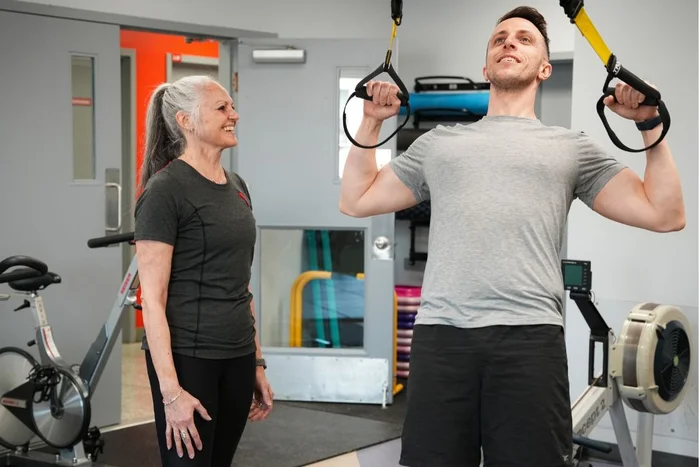
Why start at the gym with a personal trainer?
For Myriam, a few personal training sessions at the start can make a real difference. They help you learn proper technique, follow a workout plan suited to your goals and build confidence. Support can then evolve according to your needs: weekly, monthly or more occasionally.
Most importantly, take the plunge! Whatever your fitness level or experience, everyone starts somewhere. What matters is progressing at your own pace, without worrying about what others think or trying to do too much in the first few weeks.
A small win that makes all the difference
One of the benefits of personal training is learning to recognize your abilities and push yourself gradually, without going beyond your limits.
Take the example of someone who usually lifts 20-pound dumbbells. During a session, their trainer suggests trying 22.5 pounds. Hesitant at first, they take on the challenge and find they can complete the full set while maintaining good form.
For Myriam, these small wins are what make the difference. Whether it's mastering a new movement or completing a more demanding exercise, every bit of progress builds self-confidence and brings a sense of satisfaction and accomplishment.
Ready to progress and take on new challenges? The personal trainers at our YMCA centres can support you with a personalized workout plan tailored to your goals, abilities and experience.
About our expert
Myriam Dallaire, kinesiologist and personal trainer
A 2010 kinesiology graduate of the Université de Sherbrooke, Myriam Dallaire has over 15 years of experience in her field. Her further training includes rehabilitation and coaching athletes.
A personal trainer at the YMCAs of Québec for about a year, she takes a people-centred approach focused on technique, progression and small wins.